
Saving Ville-Marie (Montreal)
When asked to give a “summary of the events leading up to the Grand Recrue of 1653 in New France and the results of those efforts,” Duck.ai (artificial intelligence) generated the following:
“In New France, the “Grande Recrue” (the Great Recruit) of 1653 was a deliberate effort to reinforce Ville-Marie (Montreal) at a moment when its survival depended on manpower. Ville-Marie had been founded in 1642, but by the early 1650s the settlement faced sustained danger, especially from Iroquois raids, while its population (less than 50) and defenses remained small. For many colonists, farming and daily life outside the fortified core became increasingly hazardous, forcing families and institutions (including the hospital community) to rely more heavily on the protection of the fort. Under that pressure, leaders concluded that Ville-Marie needed fresh arrivals: armed men, tradespeople and, crucially, women who could help turn a precarious outpost into a growing community.
The recruitment effort was driven by Paul de Chomedey, sieur de Maisonneuve, governor of Ville-Marie, who returned to France to mobilize support after the settlement’s dire situation became undeniable. The goal was not merely to ship “more settlers,” but to bring a cohort large enough to change the settlement’s prospects: enough armed men to help defend the town and enough additional workers to sustain the daily grind of building, farming, and operating institutions. Maisonneuve’s preparation was closely tied to a grim contingency plan; if he could not recruit, Ville-Marie would be abandoned, highlighting how close the settlement was to an all-or-nothing moment.
By 1653, the recruitment’s urgency collided with the realities of 17th-century transatlantic travel. The main group sailed from Saint-Nazaire on June 20, 1653 aboard the Saint-Nicolas-de-Nantes. After leaving port, conditions deteriorated: the ship reportedly required repeated attention to bailing and repairs, provisions worsened, and the voyage was forced to turn back to France. During this delay and crisis, some recruits reportedly grew desperate, believing they had been taken to eternal damnation; a few attempted to escape by swimming back toward shore. After additional preparations, the expedition departed again on July 20. On this second crossing, illness spread and at least eight men died before arrival. Despite the losses and the delay, the expedition continued because the need for reinforcements had not diminished.
The expedition reached Quebec City on September 22, 1653 and then continued to Montreal. Accounts place the final arrival in Montreal on November 16, 1653. What made the Grande Recrue especially consequential was the mixture of functions it brought together: the men added to the defensive capacity and labor pool of Ville-Marie, and the accompanying women (including Marguerite Bourgeoys, who would become central to education and religious life in the colony) contributed to the settlement’s longer-term transformation from an exposed frontier fort into a community capable of growth. The immediate pressure after arrival was to consolidate the new arrivals into Ville-Marie’s fragile structure by providing housing, assigning work, and integrating families into the daily rhythms of defense and building.
The Grande Recrue did what its planners intended: it strengthened Ville-Marie at a moment when the colony’s vulnerability was acute. The men who came as recruits were described as key to “saving” not only Montreal but, in the collective memory of later writers, the wider project of New France because holding Ville-Marie mattered for the security of the region and for the credibility of settlement. At the same time, the recruitment had practical outcomes for the survivors: many received land grants and entered the work of clearing, building, and farming, turning imported manpower into local roots. Over time, the presence of new families accelerated the formation of stable social networks, church life, and militia readiness around the town. Even with deaths from the crossing and the hardships of settlement life, the Grande Recrue helped stabilize and expand Ville-Marie’s population base, thereby improving its capacity to endure continued threats.”
Of the 102 men and 14 King’s Daughters (Filles du roi) that arrived in Montreal that November 16, 1653, 5 of the men and 1 of the women are my direct ancestors; members of both the Vadnais and Peltier branches of the family tree participated in what was considered the saving of Montreal.
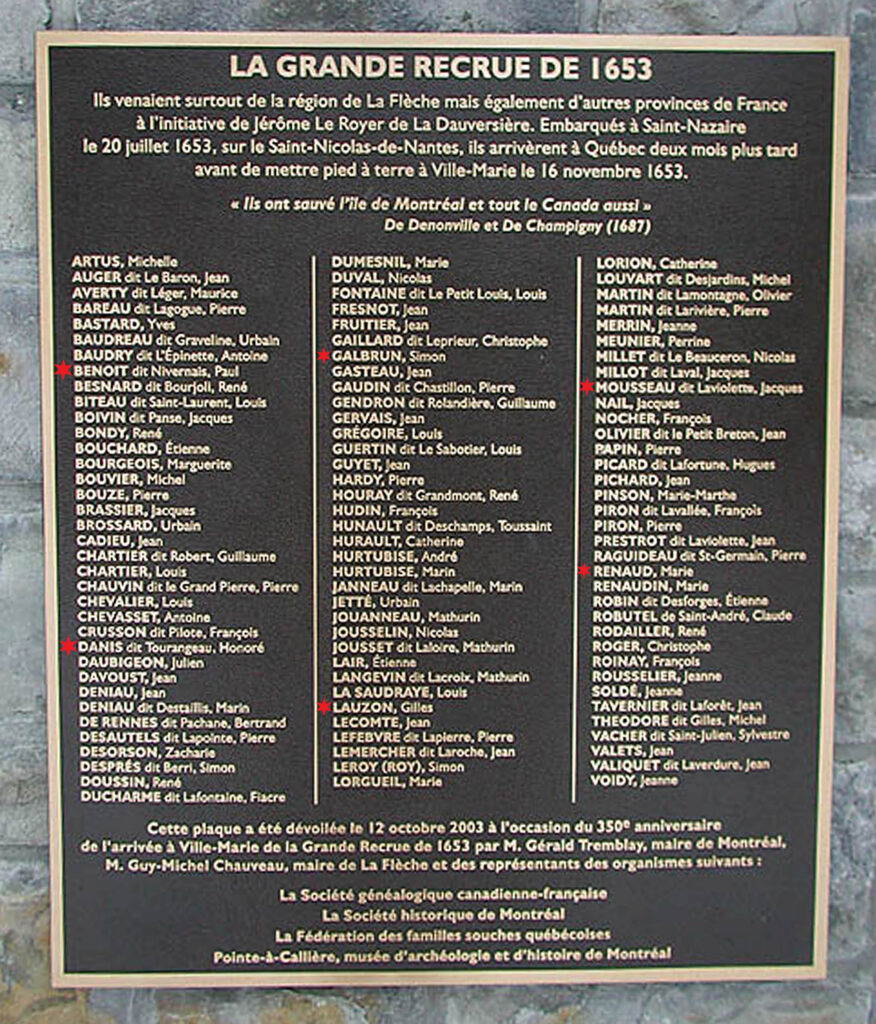
The 6 known ancestors have a red star in front of their name.
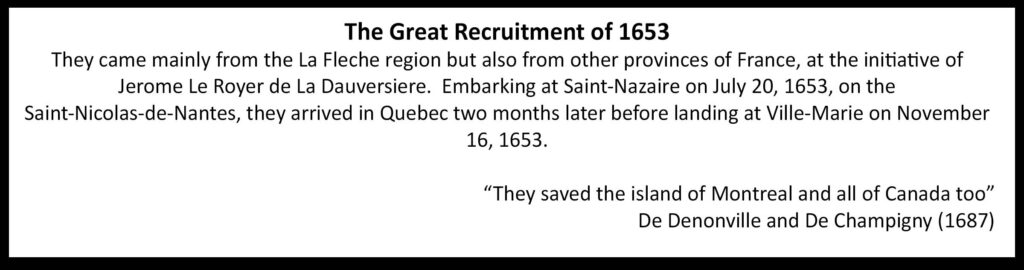
The inscription at the top of the plaque reads:
Here’s a list of my Grand Recrue ancestors and some information about each one:
Paul Benoit dit Livernois (1626-1686), my 8th great-grandfather on the Vadnais side of my family. He was 27 years old when he arrived.
Honore Danis dit Tourangeau (1629-1689), both my 8th and 10th great-grandfather on the Peltier side of my family. He was 24 years old when he arrived.
Simon Galbrun (1635-1669), my 9th great-grandfather on the Peltier side of my family. He was 19 years old when he arrived. I wrote about him in an earlier post; his wife was accused of murdering him.
Gilles Lauzon (1631-1687), my 9th great-grandfather on the Vadnais side of my family. He was 22 years old when he arrived.
Jacques Mousseau dit LaViolette (1627-1694), my 8th great-grandfather on the Vadnais side of my family. He was 26 years old when he arrived.
Marie Renaud (1637-1709), my 9th great-grandmother on the Vadnais side of my family. She was 16 years old when she arrived and had been recruited as a King’s Daughter (Filles du roi).
By the end of the French regime in 1776, the Grand Recrue pioneers of Ville-Marie counted over 45,000 descendants.
Thanks for visiting, come back soon,
Cynthia
© 2026 Copyright by Cynthia Vadnais, All Rights Reserved
Saving Ville-Marie (Montreal) Read More »