Le Grand Derangement (The Great Upheaval)
My 6th great-grandparents on the Peltier side of the family, Daniel Garceau and Anne Doucet, were both born in the Port Royal (Annapolis Royal) area of Acadia (Nova Scotia); Daniel was born on April 8, 1707 and Anne was born on November 14, 1706.1, 2
During the Queen Anne’s War in 1710 the British seized Port Royal, renaming it Annapolis Royal. It marked the beginning of permanent British control over the peninsular portion of Acadia which, as of 1721, the British called Nova Scotia. Daniel and Anne, both very young when the siege occurred, were a part of the Acadian world, living in a French Catholic society that had learned to live under British occupation without giving up their language, religion or culture.
On June 23, 1713, the French residents of Nova Scotia were given one year to declare allegiance to Britain or leave the region, a process that continued for many years. In December 1729, Daniel took the oath-of-allegiance to George II.3 He probably did it out of preservation, not allegiance; after all, he and his family were under British rule.
The conflicts/wars continued and Acadians remained a thorn in the side of the aspirations of the British Empire. Many conflicts later, during the French and Indian War, the British sought to once and for all neutralize any military threat Acadians posed, and to also interrupt the vital supply lines Acadians provided the solution; deport the Acadians. By the time Daniel Garceau’s family was caught up in this process, the “deportation” meant more than leaving home. Households were split up and properties were often seized or abandoned, never to be reclaimed. All possessions were left behind except for those that could be carried.
The “Great Upheaval,” as it was called, started in 1755 with the Bay of Fundy Campaign during which approximately 7,000 Acadians were expelled, including those in Annapolis Royal (Port Royal). The expulsion of Acadians from their land would not end until 1764. Many of the displaced ended up in Louisiana.
Daniel and Anne had been married around 1730 at St. Jean Baptiste Church in Annapolis Royal (Port Royal).4 Between 1731 and 1752 Anne gave birth to 11 children; only 10 of the 11 are shown on the following record.5
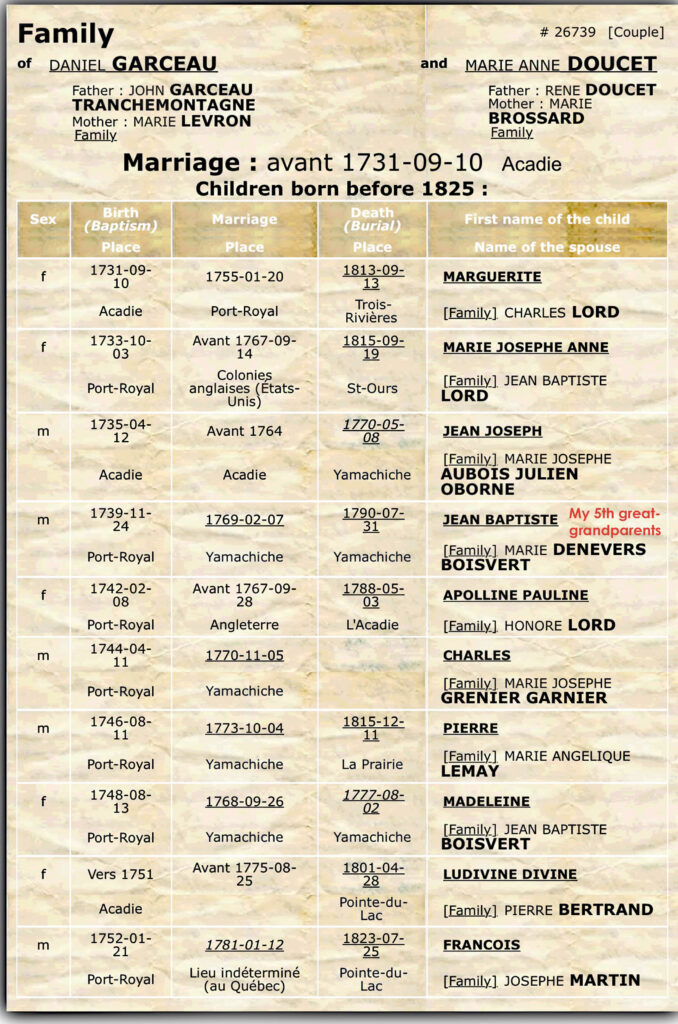
The Bay of Fundy Campaign included the Garceau family. Acadians from the Annapolis region were loaded onto British transports bound for colonies where the Crown could disperse them and put them to work. One such ship, the brigantine Experiment was bound for New York. It left Annapolis on December 8, 1755 and reached New York on January 30, 1756, with about 250 Acadians aboard. Daniel’s family is frequently linked to the New York deportation wave.
Once Acadians disembarked at New York, they were detained, enumerated and then dispersed to surrounding counties. They were often indentured to absorb labor needs and reduce public burden. I cannot imagine that they were welcomed with open arms.
The Garceau family: Daniel, Anne and 8 of their children are documented on immigration lists as arriving in Connecticut, which is a bit misleading because what the records contain is generally the place of first residence, not the place where they initially arrived.6 Daniel was probably put to work as a cooper (barrel maker), a trade he knew and would practice all of his life.
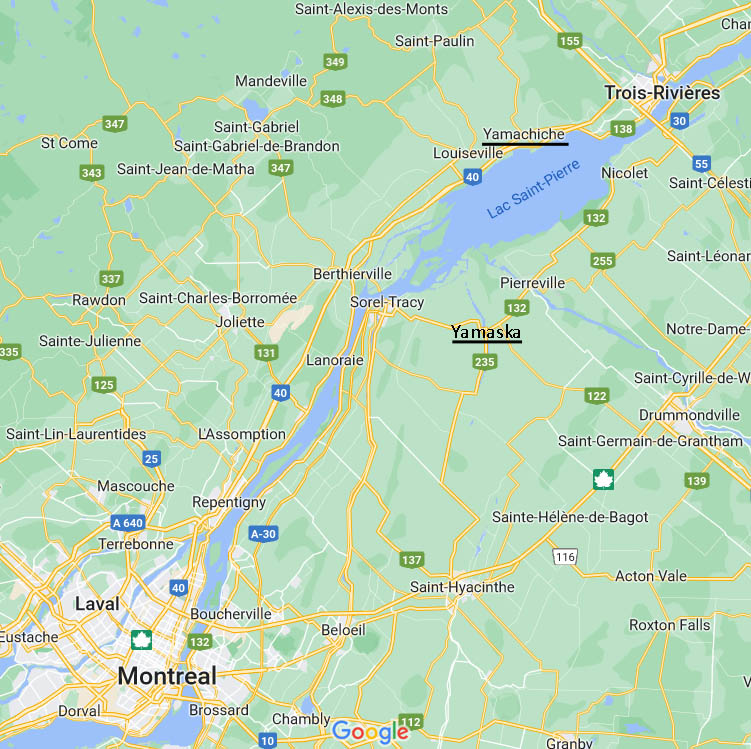
Somewhere around the mid 1760s, records show displaced Acadians seeking transportation “to France,” but the Garceau family did not end up in France, or Acadia where they were born. Instead, when they left the United States they settled in Quebec around the Yamachiche area, a municipality on the north side of the St. Lawrence River southwest of Trois-Rivieres.
Daniel died on August 28, 1772 at 65 years old and Anne died on April 14, 1791 at 84 years old.7,8 Daniel was buried in Yamachiche and Anne, after having remarried, was buried in Sorel.
Three more generations of my Garceau ancestors were born in Yamachiche, the last direct ancestor being my 3rd great-grandfather, Jean Garceau.9 On November 8, 1825, Jean married Marie Ann Gingras at Saint-Michel d’Yamaska, Pierre-De-Saurel, Quebec, a community not far from Yamachiche on the south side of the St. Lawrence River.10 They made their home in Yamaska and it is where 10 of their 13 children were born.11
In 1846, Jean immigrated to the United States.13 Unlike his great-grandfather Daniel, Jean and his family were not physically forced to leave their home. During the mid 1800s there were a variety of reasons why French Canadians were leaving, one of which was that the British were making the French way of life in Canada more difficult; I think Daniel and his family had understood this all too well.
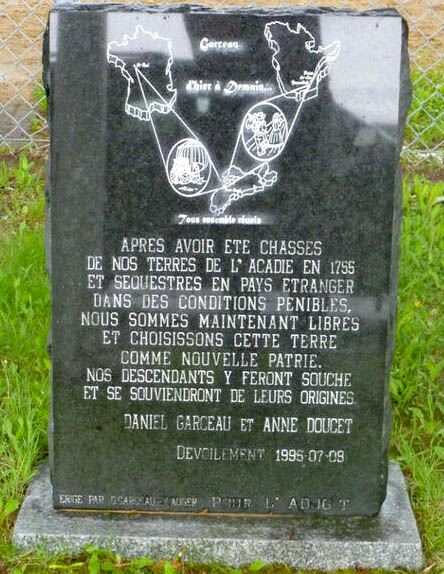
It reads: After being driven from our Acadian lands in 1755 and held captive in a foreign land under harsh conditions, we are now free and choose this land as our new homeland.
Our descendants will settle here and remember their origins.
Daniel Garceau and Anne Doucet
Unveiling 1995-07-08
Thanks for visiting, come back soon,
Cynthia
© 2026 Copyright by Cynthia Vadnais, All Rights Reserved
Le Grand Derangement (The Great Upheaval) Read More »